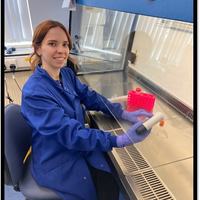
What course did you study and where?
I initially did a Level 5 Laboratory Scientist Apprenticeship with an FdSc in Applied Biosciences. I later enrolled to top up the degree to a BSc Applied Biosciences with a Level 6 Laboratory Scientist Apprenticeship. I completed all my studies online with the University of Kent, graduating in 2025 and completing my apprenticeship end-point assessments in 2026.
How did you get your job?
I had already been working at the University of Nottingham as a research technician for many years during my apprenticeship, when an internal vacancy came up for a technical manager in the sequencing facility, I applied for the role and was successful.
What's a typical working day like?
Some days I meet with potential customers to discuss their research projects and how we can support them, and other days I generate quotes or manage finances and ordering. I also attend strategic planning meetings and meet with suppliers to learn about new emerging technology.
My favourite days are when I head off to events and conferences, to both promote the facility, and to network with other researchers.
What do you enjoy most about your job?
I really enjoy meeting with other researchers and learning about their projects. I particularly enjoy finding a way to help them with problems when they're struggling with difficult samples or research questions.
Some of the best skills to develop to get into this role are troubleshooting and being able to communicate complex ideas to a variety of different audiences. I also love going to events and speaking about my career or projects, as it opens up so many new opportunities.
What are the challenges?
One of the biggest challenges in science is that experiments don't always work the way you expect them to. Research often involves a lot of troubleshooting, optimisation and repeating experiments before you get the result you're looking for. It can sometimes feel like progress is slow, but that's just part of the process. You need to be patient, resilient and keep a positive mindset, learning from the things that don't work as well as celebrating the things that do.
How is your degree relevant?
My degree has helped me so much. It gave me a good general understanding of a broad range of biological sciences. It also taught me a lot about project management and business improvement, and those are the modules that support me the most today.
How has your role developed and what are your career ambitions?
I started as an apprentice technician in 2016. After completing my Level 3 Laboratory Technician Apprenticeship, I moved to a technician role in 2018 rotating around various research labs. After several years I progressed to a senior technical role supporting many research groups, as well as being actively involved in lab work where I managed to be authored on several research papers. Eventually after completing my degree apprenticeship, I moved into a technical manager position.
My role has continued to change as my skills and experience have developed and my employer's research needs have changed. I'm new in my role so am looking forward to developing a whole suite of new skills as I become more established. I'm really excited to see where my skills and experience take me next.
What advice can you give to others wanting to get into this job?
Apprenticeships are an amazing way to get into this career. If you manage to find a traineeship or apprenticeship programme that allows you to experience multiple labs, it will help you understand the types of lab/research you enjoy and excel in the most.
Find out more