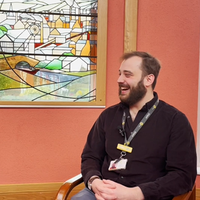
Spiritual, pastoral and religious care community practitioner - Harry Barrat
Harry decided to change careers in his twenties, embarking on a Postgraduate Certificate (PGCert) in Pastoral Care and a period of volunteering. He now works as a spiritual, pastoral and religious care (SPARC) community practitioner at Dougie Mac Hospice
What degree/qualifications did you study and where?
I started by completing the Non-Religious Pastoral Support Network’s (NRPSN) volunteering weekend course, which gives you the basic skills and accreditation to start volunteering as a non-religious chaplain.
While volunteering, I did a week-long course at Guys and St Thomas's Hospital Trust, and a PGCert in Pastoral Care: Existential and Humanist Practice from the Existential Academy and Middlesex University. I am currently completing more modules to turn the PGCert into a Masters degree.
What inspired you to pursue a career in chaplaincy?
In my twenties I completed a doctorate in biochemistry, and I loved it. But it made me realise that I wanted a career that explored the most important and deepest questions, rather than ones that were just about the natural world.
I wanted to understand how we:
address the absurd, difficult and wonderful nature of being human
cultivate rich and meaningful lives
respond to suffering.
I listened to a podcast about the first Zen hospice in the USA, and it made me realise that chaplaincy could be it.
I'm not religious, so I wasn't sure what this could be in terms of a profession. Then the NRPSN advertised that they were training non-religious chaplains, so I re-trained, started volunteering, and eventually switched careers.
How did you get your job as a chaplain?
I volunteered for two years as a prison chaplain and a year as a hospital chaplain. This required me to have a four-day work week and volunteer on the fifth day. Eventually, alongside doing the PGCert, I had enough qualifications to compete for a paid post.
I was prepared to move anywhere in the UK to get my foot on the ladder. A post came up in the Midlands, so I applied with the intention of relocating, and I got it.
What kind of tasks do you complete on a typical day?
I'm a community chaplain for a hospice, so most of my day is spent visiting patients in their homes and providing:
pastoral
religious
spiritual care.
After my appointments, I write up my visits, and if necessary, arrange my next set of visits for the week. It is a deeply satisfying post, as most of my time is spent providing care with very little admin required.
The hospice nurses triage patients, so I'm always visiting those who want me there.
I also mentor and arrange visits for our SPARC volunteers and provide training for staff. Occasionally, I conduct a patient's funeral or wedding, and run remembrance services.
What part of your job brings you the most satisfaction?
I find that engaging with people at a profound existential level every day deepens my sense of humanity. Witnessing and helping others find a path through suffering feels like a sacred task. I am reminded every day that life is precious and that time is limited, and I find this gives me an enormous sense of gratitude and compassion.
What are the challenges?
Often, chaplaincy is about walking alongside someone, and it's impossible to 'fix' their circumstance. Some people find this very difficult. You also have to allow people to say what they think and feel. In doing so, you invite some of the darkest aspects of being human, and you have to be able to engage with people at this level. Many of the people I care for want to explore:
dying
guilt
self-loathing
the loss of autonomy
the loss of identity.
What three skills are most valuable in your role as a chaplain?
pastoral care is the art of listening
spiritual care is the art of understanding how people find meaning
religious care is about religious literacy.
You need to have a basic understanding of all three in order to be an effective chaplain (regardless of your own belief).
What type of person would suit this career?
Someone who loves deep conversation and exploring existential questions. Someone who is a good listener and is curious about how people navigate life.
What advice can you give to other aspiring chaplains?
Volunteer. It's the backbone of understanding if it's for you, and practice is the only real way you can improve your pastoral care.