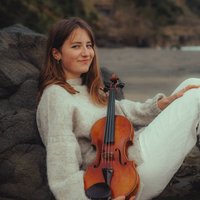
Jessica completed a BA in music followed by an MSc in music therapy. She now works as a music therapist at a residential therapeutic school for children and young people who need additional social, emotional and mental health support
What inspired you to pursue a career in music therapy?
Growing up I struggled with feelings of low mood and anxiety. I tried cognitive behavioural therapy (CBT) and counselling, but felt it wasn't until I started psychotherapy and life coaching at 21 that I really began to understand myself and start to self-reflect. This was all happening during COVID-19, and I felt I would like to work in a role that helped others.
I considered training to become a social worker or a psychotherapist, before talking to a fellow music graduate, who had trained as a music therapist. I realised I could explore how my connection to music could potentially support me to build relationships with others who may value therapeutic support.
How did you get your job as a music therapist?
I actually spent ages looking for jobs before I graduated, and I really struggled to find music therapy roles. One day my best friend sent me a link to a job that was advertised in The Guardian, and it was based in the town we grew up in. I was offered an interview, and then before I knew it, I was moving back to where I grew up. Don't discount looking in your local newspapers as you never know what might be out there for you.
What kind of work experience is useful when trying to secure a job as a music therapist?
In my interview I found myself drawing on my experience of working in a boarding school - something I did before I started my music therapy training. This was useful, as it meant I'd experienced what it was like to be a full-time member of staff in a school and I could build on those transferable skills alongside my music therapy training.
What tasks do you complete on a typical day?
Day-to-day, my schedule includes:
Meetings - attending staff briefing, multidisciplinary meetings, and catching up with educational and care staff to ensure a joined-up approach. With each child I work in collaboration with their families, teaching, and pastoral staff, drawing from their Education, Health and Care Plans (EHCPs) and supporting context, alongside the views of the children themselves to ensure I tailor our sessions to their needs and hopes.
Clinical work - sessions (two to five a day) and note-taking. I manage a caseload of up to 20 clinical hours a week, facilitating individual and group sessions. In my sessions, I use a variety of techniques depending on who I am working with. Individual sessions sometimes involve shared music listening and creative reflection, songwriting, art making, role play, playful improvisation, free associative singing, and curating tracks with music technology. Group sessions are tailored to age group, need, therapeutic hopes, and the structure is often determined or negotiated together as a group. This may include musical check-ins/outs, games such as pass the sound or follow the leader, calm reflections, and imaginative play. My psychodynamic, person-centred training is interwoven into my approach as a music therapist, shared decision making, improvisation, and the young person’s voice is at the core of my approach.
Planning and preparation - making resources or reading over notes.
Creative reflection - creating art, writing songs, or making music based on sessions. I also facilitate weekly reflective practice for my colleagues, using creative methods to encourage deeper understanding of what may be going on for our children and young people.
Everyday school activities - a therapeutic lunchtime activity such as clay, colouring or reading.
What part of your job brings you the most satisfaction?
Some sessions can feel hard, but also really powerful. For me, the most satisfying part of my role is when we feel 'stuck' in the therapeutic process, and then a breakthrough happens. This could look like:
a young person coming back to therapy after needing to take a break
facilitating a new way of playing an instrument
experiencing a young person gradually feeling comfortable enough to go deeper with their creative exploration, unlocking new perspectives and ways of seeing their music and experiences.
I personally love sessions that are free-flow music the whole time. I feel that these sessions are often really connecting and can be so insightful.
What are the challenges?
I am naturally a team player, and I love working collaboratively. I feel grateful that I can work collaboratively with young people, but music therapy can sometimes feel lonely, as you are often working as an autonomous practitioner.
I combat this by fostering relationships with a strong circle of colleagues and supporting professionals whom I trust, so we can support our young people together. I believe that music therapy is never an isolated process, and that the environmental factors may influence the therapeutic process more than you know.
What three skills should all good music therapists possess?
imagination
resilience (alongside the vulnerability and humility to ask for support)
the ability to ground yourself.
What type of person would suit this career?
Music therapy can look different for each individual, client group, and setting. Therapy is deeply personal, and as a therapist - like it or not - you bring part of you into the room. As a music therapist, I've found myself developing my self-awareness and reflection, and I've needed to be flexible and creative with my ideas and expectations. Most of all though, a caring and compassionate nature would ideally be at the heart of any music therapist’s approach.
What are your career ambitions?
I’ve recently loved getting involved with the Forest School where I work and have seen how this can support children to:
build connections
creatively explore
learn to respect and love their environment
take appropriate risks.
As someone who loves being outdoors, I hope to combine the therapeutic experience of outdoor activities with music and one day set up my own forest-based music therapy practice.
Can you debunk a myth about working as a music therapist?
I get so many (well-meaning) people saying, 'I listen to music before going to sleep, it's so therapeutic' or 'Going in there and banging a drum must feel great.' That’s the power of music, not music therapy - at the core of music therapy is relationship. It is what happens in the relational space between the music therapist and the client that makes it music therapy.
Are you a member of a professional organisation? If so, how has this aided your career?
Yes, I belong to the Health and Care Professions Council (HCPC), and the British Association for Music Therapy (BAMT). I'm really grateful for my mentoring group, as part of BAMT's Newly Qualified Scheme - they have kept me sustained and inspired through both tough and wonderful moments. I love how rich and thoughtful our discussions can be, and it's so good to hear perspectives from colleagues who will share incredible ideas and can step back and help you look at things differently.
What advice can you give to other aspiring music therapists?
I would encourage aspiring music therapists to approach their career journey with:
curiosity
patience
self-compassion
wonder.
It's a remarkable process and you will learn so much about yourself and others.