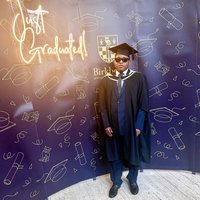
Why did you decide to pursue this course at this university?
I chose to study an MSc in international development to build on the knowledge from my undergraduate degree in development studies. I've also been a development practitioner throughout my career.
I picked Birkbeck College, University of London, based on its national and international rankings, especially in research, which is critical in international development. In addition, I found Birkbeck's flexibility to study in the evening very convenient.
At what stage did you choose to disclose your disability/condition? Why at that point?
I disclosed my disability as a severely sight-impaired person at the initial stage of my university application. This was because I wanted them to know my condition as soon as possible, so they could provide me with the support I needed during my studies.
Did any specific adjustments make a difference to how well you felt able to perform at university?
As the first blind person to undertake postgraduate studies at that faculty, the department provided a senior lecturer to liaise with to determine the appropriate support.
The initial meeting informed them of the kind of support I needed, and they provided me with tutorial materials in accessible formats, which helped to improve my performance. This made a great difference in my studies, as I received the texts on time, making it easier for me to study. The library staff were also supportive by providing me with other texts in an accessible format.
How did you fund your Masters?
My Masters was mainly funded by Student Finance England, while I also received a £3,000 scholarship from the college.
What did the course teach you that your first degree did not?
The course gave me a deep understanding of new skills and knowledge about social justice. I have been a social justice campaigner in disability activism in the civil and public sectors in my home country, Sierra Leone.
During my stay in the UK, I have focused on advocating for policy and legislative reforms for asylum seekers and refugees, especially for people with disabilities, but I had never studied social justice in my academic pursuits until this level.
This has broadened and strengthened my skills and knowledge in social justice advocacy, research, and international development.
Tell us about the Masters course and how it was assessed.
The Masters was rigorous and required critical thinking and analysis. It is not just about taking what you learn and read in the classroom for granted; you are required to further read and critically analyse with evidence-based knowledge.
Each module had two briefs, ranging from 2,500 to 5,000 words, and a dissertation of 12,000 to 15,000 words.
My MSc degree comprised the following modules:
- Critical Research in International Development
- Environment and Policy
- International Development and Social Justice
- Race, Environment and International Development.
I also did a dissertation titled 'The Impact of Brain Waste Among Migrants in the UK', and I achieved a Merit overall.
What do you wish you'd known before embarking on postgraduate study?
I wish I had known how racism had contributed to environmental injustice, environmental degradation, and disasters around the globe.
I would have extended my advocacy campaigns on environmental policies that continue to negatively impact indigenous people in the Global South (covering Africa, Latin America, Asia, and Oceania).
Briefly tell us what you've been doing since graduation.
I'm a part-time community researcher at People Street, a research organisation working with UK government agencies. My key role is to ensure that the voices of disabled people are included in all research projects and to influence decision-makers to develop policies that are fully inclusive of disability.
I also serve as a board trustee for Cotton Tree Trust, a charity that supports asylum seekers and refugees.
I have increased my search for a full-time job while exploring the possibility of setting up a charity or community interest company (CIC) to either complement or fill gaps in disability advocacy and research.
How have you approached finding a job?
I signed up with Evenbreak to receive daily vacancy updates, which you can personalise, and have been actively applying for roles. I've already secured several interviews and have used each opportunity to learn and develop my interview technique as I continue to progress my search.
I also search for jobs on LinkedIn, with charity recruitment specialists Harris Hill and relevant job boards.
What advice would you give to others about disclosing a disability?
Disabled graduates and job applicants should feel confident about declaring their disability at the start of any application, whether for admission to postgraduate studies or for job recruitment. This will enable organisations to provide the appropriate support in any form of adjustment.
Find out more