What inspired you to study in the UK?
My decision to study in the UK was inspired by a desire to move from being primarily a public health advocate and practitioner to becoming someone who can also contribute meaningfully to the policy and financing decisions that shape health outcomes in my country and beyond.
Much of my work has been rooted in communities in Nigeria and across Africa. Through malaria advocacy and mental health and disability inclusion work, I've seen that effective health interventions are only part of the solution.
The harder questions often concern political commitment, financing, implementation, accountability, and how national and subnational systems translate policies into community services.
The UK hosts some of the world's top universities and has a particularly strong ecosystem for:
- global health research
- health policy
- public health.
Studying here gives me access to institutions, academics, policymakers and practitioners working at the intersection of evidence and decision making.
With these factors in mind, I chose the UK. My choice was not just about obtaining another academic qualification. It was about acquiring the tools and perspectives I need to return to Nigeria and contribute more effectively to strengthening the health system.
Why did you decide on this joint programme at these two UK universities?
I chose to study the MSc Health Policy, Planning and Financing (HPPF) because it sits almost exactly at the intersection of where my professional journey has taken me and where I want to go next.
I have spent years working on the advocacy and communications side of public health. Through my work, I have seen firsthand how important evidence and community voices are. However, I also realised that advocacy alone is not enough. I needed to understand how policies are developed, how institutions make decisions, how health systems are planned, and how limited resources are allocated.
Choosing HPPF was easy. It's a three-in-one package covering health policy, health planning, and health financing from two leading universities.
I figured LSHTM would give me a strong grounding in public health, health systems, and global health, while LSE would offer a deeper perspective on economics, policy, politics, and institutions. That combination is crucial to the work I hope to do.
So, because I want to understand both what should be done to improve health outcomes and why particular policy and financing decisions are made in the first place, I decided to apply for this programme.
Why did you apply for a Chevening Scholarship?
When I decided to pursue postgraduate study, I made Chevening my first and only scholarship choice. Given the competitive nature of the situation, this was a risk, but I was really determined.
The obvious attraction was its prestige, but what really appealed to me was the strength and diversity of the Chevening community. I have some Chevening and LSHTM alumni in my network, and I've seen how they think and act.
So, when I was seeking MSc opportunities, I was not only looking for funding to study in the UK. I wanted to join a network of people who were already making a difference in their countries and who could challenge my thinking, expand my networks and become collaborators in the future; Chevening matched these criteria.
What does your Chevening Scholarship cover?
Chevening provides a comprehensive scholarship package. It covers:
- tuition fees
- economy travel to and from the UK
- visa-related costs
- a monthly living stipend intended to support scholars during their studies.
The scholar's final award letter (FAL) sets out the exact allowances. For me, the value of Chevening extends well beyond its financial support.
The scholarship gives scholars opportunities to engage with one another, alumni, policymakers, high-profile speakers, and partner organisations through its wider engagement programme.
What did the Chevening application process involve, and how competitive was it?
It requires applicants to demonstrate much more than academic ability. The application asks you to reflect seriously on your:
- ability to build networks
- leadership and influence
- plans to create an impact in your country after your studies
- reasons for studying in the UK.
I found the process both challenging and valuable because it forced me to step back from my day-to-day work and think about the bigger story behind it - what I had achieved, what I had learned, the people I had influenced, and where I wanted to go next.
The Chevening cycle runs over several months from August to October. Chevening assesses eligible applications, invites shortlisted candidates to interview in March and April of the following year, and announces results from mid-June.
It is highly competitive, so applicants need to understand that Chevening is not simply looking for the person with the longest CV. They look for people who can demonstrate:
- a clear vision
- influence
- leadership
- the ability to use their experience and networks to contribute to national and global development.
What do you wish you'd known before applying for Chevening?
I wish I had understood earlier just how much of an investment Chevening makes in its scholars beyond the scholarship itself.
When I applied, I was mainly thinking about the opportunity to study in the UK and the prestige of being a Chevening scholar. I understood the importance of the alumni network, but I didn't fully appreciate how powerful the wider community could become.
The scholarship's real value lies in the people you meet, the conversations you have, the ideas you exchange, and the relationships that can develop across countries and sectors.
Before coming to the UK, you founded Block Malaria Africa. What inspired you to start the organisation?
Growing up in Jos, North-central Nigeria, malaria was part of everyday life. I saw friends fall ill, families struggle with the consequences of the disease, and, most painfully, a close friend lost his 14-year-old younger brother to malaria, a preventable and treatable disease.
As an undergraduate, I participated in a World Malaria Day outreach. The following year, when no similar activity was planned, I took the initiative to organise a malaria awareness campaign in rural Jos North. With a few friends, we eventually started what has now become Block Malaria Africa.
You were invited to speak at the All-Party Parliamentary Group on Malaria and Neglected Tropical Diseases reception. What was that experience like?
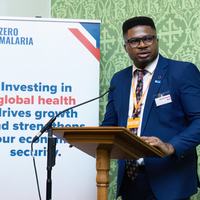
Standing inside the UK Parliament and sharing my malaria story was an amazing experience, but what made it exciting for me was the opportunity to bring the voices and experiences of the communities I represent - those affected by malaria into a room where political and policy decisions are discussed.
I shared my own experiences with malaria and highlighted the importance of sustained financing, meaningful youth engagement, and stronger collaboration between governments, researchers, communities, and other stakeholders.
You've worked in malaria prevention, mental health and disability inclusion. How have these experiences shaped your approach to leadership?
My work in mental health and disability inclusion has been particularly interesting. I managed a two-year donor-funded project focused on strengthening access to mental health services and disability inclusion for children and youths with disabilities and their caregivers in Plateau State, North-central Nigeria. I also became involved in advocacy around Nigeria's Mental Health Act and led efforts to advance mental health policy in Plateau State.
Generally, these experiences have made my leadership approach more collaborative. I do not believe leadership is about having all the answers. It is about creating the conditions for people to contribute, recognising expertise in different forms and building coalitions around a shared vision.
What does being a Chevening scholar involve?
Being a Chevening scholar involves much more than attending a UK university.
It means joining a community of potential world leaders and changemakers. This comes with a responsibility to learn from others, actively contribute to your community, and make meaningful use of the opportunity.
I've been constantly asking how I can connect what I am learning in the classroom with the challenges I have encountered in Nigeria and across Africa.
It also means being an ambassador for your country and your work. Every conversation with another scholar, academic, policymaker, or member of the public becomes an opportunity to share a different perspective on Nigeria and the issues I am passionate about solving.
What has been the highlight of your course and wider Chevening experience so far?
It has been connecting my practical advocacy experience with rigorous academic thinking about policy, power, and health systems.
At LSHTM, modules such as 'Health Policy, Process and Power' have challenged me to think differently about experiences I previously understood primarily from a practitioner perspective. I have become particularly interested in the relationship between evidence, political power, institutions and policy change.
Outside the classroom, the opportunity to engage with the wider global health community in London has been equally valuable. Speaking at the UK Parliament about malaria was one of those moments when my academic journey, professional experience and personal motivation aligned.
As a people person, I can also say that the quality of people I have networked with across classrooms, side events and hangouts has been one of the biggest highlights of my experience in the UK.
What makes a strong Chevening candidate?
A strong Chevening candidate demonstrates leadership, clarity of purpose, and the ability to influence others, while remaining open to learning.
You do not need to have changed the world before applying. What matters is being able to demonstrate that you have identified a problem, acted, positively impacted people, and learned from the experience.
I would also emphasise authenticity. The strongest application is not necessarily the one with the most impressive-sounding achievements. It is the one where the applicant can clearly explain why they care about the issues they are working on, what they have learned and how studying in the UK fits into their long-term goals.
Finally, I think strong candidates understand that Chevening is as much about networks as it is about individual achievement. You should be able to show not only what you have done yourself, but how you work with others and how you intend to use the relationships you build to create a wider impact.
How do you hope your Chevening and university experience will help you improve healthcare outcomes or create positive change in Nigeria?
My long-term goal is to contribute to stronger, more equitable and more sustainable health systems in Nigeria.
This experience has shown me that health outcomes are shaped by much more than the availability of medical interventions. They are influenced by:
- accountability
- community participation
- financing decisions
- institutional capacity
- political priorities.
Ultimately, I want to bridge the gap between evidence, policy and implementation. I want my work to help ensure that communities are not only heard when policies are developed but also that those policies translate into better health outcomes for them, and I'm hopeful that my Chevening, LSHTM, and LSE experiences will help me achieve this.
What advice can you give to others thinking about applying for a Chevening Scholarship?
- Start early. The Chevening essays require serious reflection, not just form-filling. Give yourself enough time to reflect on your leadership experiences, your career trajectory, and what you genuinely want to achieve.
- Tell your own story. Don't try to write what you think Chevening wants to hear. Your experiences, challenges and motivations are what make your application unique.
- Demonstrate impact rather than simply listing achievements. Instead of saying you led an initiative, explain what you did, who you worked with (mention these names), what changed and what you learned.
- Be clear about your career plans. Chevening invests in future leaders, so your application should make a convincing connection between your previous experience, your proposed study plan, and the change you want to create afterwards.
- Don't underestimate the Chevening network. While you apply because you want to study in the UK, also keep in mind that you're applying to become part of a global community. The relationships you build through Chevening can become just as valuable as the degree itself.
Find out more