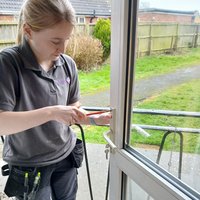
What qualifications did you hold prior to the apprenticeship?
Before doing any apprenticeships, I only had my GCSEs and A-levels in criminology, psychology and product design. I then decided I wanted to move to York to get a degree in product design.
However, after my first year, I decided I didn't want to do that degree anymore and moved back home and worked full time at a local petrol station, where I used to work part time before moving away for university. I knew that's not what I wanted to do forever, but I was very set on the kind of career I wanted.
Why did you decide to do an advanced apprenticeship in this industry?
Before starting at Platform, I never really considered apprenticeships as an option. I never thought about working in the trades, but now I am so glad that I do.
I'm learning skills for life by doing an apprenticeship, and it works well for me because I learn best through practical work. I always did better at school with the practical subjects.
For my PMO course, I only went to college one day a week. It was half a day of theory, and the other half was practical, which worked well for me.
Before I started working at Platform, I had no experience in the trades and no idea where to start. When I found out I'd been offered an interview for my PMO apprenticeship, I did a day of work experience with an extended family member who is a self-employed plumber, and I really enjoyed it, which made me even more keen to get the job so I could learn more.
How did you find and apply for your apprenticeship with Platform?
It was my mum who found the PMO apprenticeship advertised on Indeed, and she sent me the link. Originally, I thought I couldn't apply for the job as stereotypically working in the trades is a 'man's job'.
Even though I had no experience, I thought it would be a good opportunity to learn new skills. My mum reassured me that they can't dismiss me as a candidate for the job just because I'm a female. So I applied, a couple of weeks later got an interview offer, and got the job two days after my interview.
When I was nearing the end of my PMO apprenticeship, I was talking to a colleague about my next steps after I completed my exams, and he told me that the heating apprenticeship had come up on the Platform website.
Pretty early on in my PMO apprenticeship, I decided that plumbing was my favourite trade, and he told me that the heating apprenticeship would suit me quite well.
How did the PMO apprenticeship work?
I would go to Lincoln College every Monday and be on-site for the rest of the week.
The PMO apprenticeship was a two-year course, and I completed it in the minimum time of one year and one week.
At college, we would use the morning session to practice our practical skills at different workstations, including:
- plumbing
- plastering
- window glazing
- other tasks.
In the afternoon, we would go to a computer room and complete the theory work for our multiple-choice exam, which would be part of the final exams at the end of the course. We would also work on our portfolios and ask the tutor any questions that we had regarding the work we were doing.
At work, I would be exposed to different tasks every day, from Tuesday to Friday. I worked on the voids team, so work was always different, depending on what the property was like when the previous tenants moved out. Some properties could be a new kitchen and bathroom, which typically involve:
- joinery
- painting
- plastering
- plumbing
- tiling.
Other days, it could just be simpler jobs, like changing a sink tap.
The final exams included:
- a 40-question multiple-choice exam
- a 10-hour practical exam that involved various tasks
- an hour-long professional discussion in which I spoke about my portfolio.
What was your experience of college like?
To start with, I didn't enjoy college that much; it can be quite intimidating being the only female in a large group of boys. I also joined college later than the rest of them, so friendships had already been formed.
However, I soon realised it didn't matter that I was the only female and quickly got on with the work. The college itself was good, and I had a lot of support from the tutor and the student support team.
After a couple of weeks in college, I started to get into a routine. I was the first student in my group to complete all the work and was the first to be put forward for the final exams, and I passed with an overall merit.
How did you strike the right balance between study/work?
I always liked to make sure I was ahead with my work. Even if I was absent from college for whatever reason, I made sure all of my work was up to date.
At college, we had plenty of opportunities to complete our theory work during the afternoon sessions. I would also go home every Monday and make notes of all the theory work we had done, so I would have the right notes ready for exam revision.
When I was at work, the only thing I had to do was document the tasks I was doing through photos for my portfolio, along with an explanation of what I had done.
What support did you receive from the college and your employer?
Throughout my college course, the staff were really supportive and were always there for me. There were some points throughout my course where I doubted my ability and whether I was on the right path, and my college tutor was always there to reassure me.
Work was the same; if I ever had an issue, I could go to any of my colleagues or even to my line manager. I never felt like I was ever treated differently because of my gender.
What have you enjoyed most about your apprenticeship?
I enjoy working with a range of people in the industry and learning my own way of doing things. Once I was confident with certain tasks, my mentor would let me take over and see how I would tackle them.
At the end of every job, I get satisfaction knowing I have improved a house for someone to live in - whether that's improving the house before they move in or installing a new boiler so they have heating and hot water. It's always a rewarding feeling to complete a job.
What has been the most challenging part of your apprenticeship?
When I first started at Platform, I found it really difficult transitioning into a male-dominated environment and was not sure who to talk to when I had a problem.
My first line manager was so supportive and reassured me that I was no different because I was a female. Even though I'm now on a different team, I still talk to him regularly to show him what I'm getting up to. As time went on, my confidence grew, and I settled into my role.
What are your career plans?
My plans after this Level 3 apprenticeship are to continue further and gain more heating qualifications, such as my oil qualification.
What advice would you give to others looking to do an apprenticeship?
- Don't let anyone tell you that you can't do something you want to do. If you can believe you can do it, go for it.
- Always try your hardest to do the best job you can.
- Keep challenging yourself, as it's the best way to develop your skills.
- Remember that it's okay to make mistakes in this job. It's a way of learning, and while I hate making mistakes, they always make me try even harder.
Find out more